
Best overall: official state unclaimed property searches. Best for searching participating states together: MissingMoney. Best for lost pension benefits: the Pension Benefit Guaranty Corporation (PBGC). These are the strongest starting points among free unclaimed property search tools in 2026; the right choice depends on who holds your money.
- Official state portals are the best free unclaimed property search tools for checking state-held money and submitting claims.
- MissingMoney helps you search participating states together; check individual state portals for gaps.
- PBGC and federal court searches cover different records, not replacements for state searches.
- Owedtoday helps organize personalized searches and claim tracking; it is not a government agency.
Why this matters
Unclaimed money does not sit in one complete national database. State property offices, pension programs, federal courts, and wage investigators maintain different records. A clean result in one search does not clear the others.
For 2026, start with your address history and the type of money you are trying to find. Owedtoday is a self-service tool for building a personalized search list and tracking claims across state, federal, retirement, and court sources. Owedtoday is not a government agency. Official claiming is always free.
This guide separates search tools from directories and claim authorities. That distinction matters: finding a possible match is not the same as proving the money belongs to you.
What makes the best unclaimed property search tools
Use these criteria to choose your starting point, rather than treating every search box as interchangeable:
- Record coverage: The tool searches the kind of money you are missing, such as state-held property, pension benefits, or court funds.
- Source authority: You can identify the government office or program responsible for the record.
- Search flexibility: You can check former names, spelling variations, and locations where the search supports them.
- Claim handoff: A result explains which authority handles ownership verification and the claim.
- Coverage transparency: The tool makes its limits clear instead of suggesting one search checks everything.
- Follow-up clarity: You can record the result, responsible office, and next action without confusing separate claims.
Choose coverage first, convenience second. A convenient search that excludes the relevant records cannot answer your question.
Free unclaimed property search tools at a glance
The order below reflects where to start, then which specialized source to use. It is not a claim that a state search replaces a pension or court search.
| Tool | Best for | Standout feature | Key limitation |
|---|---|---|---|
| Official state unclaimed property portals | State-held money and direct claims | Search and claim instructions from the responsible state | Requires separate checks across relevant states |
| MissingMoney | Searching participating states together | A shared search across participating jurisdictions | Does not cover every source of unclaimed money |
| NAUPA state directory | Finding the correct official state program | Routes you to state unclaimed property offices | A directory is not a complete claims database |
| PBGC missing participant search | Pension benefits connected to PBGC programs | A dedicated retirement-benefit search | Does not cover every retirement account or plan |
| U.S. Courts Unclaimed Funds Locator | Funds held by participating bankruptcy courts | Search focused on bankruptcy court funds | Court participation and records have limits |
| Department of Labor Workers Owed Wages | Back wages recovered by federal wage investigators | Search for wages the department is holding | Not a general paycheck or property database |
1. Official state portals: best for state-held money
Official state unclaimed property portals search property reported to the state, including certain dormant accounts, uncashed checks, and insurance proceeds. When you find a possible match, the state's instructions explain how to establish ownership.
Search states where you have lived, worked, or maintained financial ties. In your 2026 search, an old address is a clue, not a reason to reject a result.
State portal pros:
- Direct access to the office responsible for state-held property.
- Claim instructions tied to that state's process.
- A useful place to check names and previous addresses.
State portal cons:
- You must repeat searches across relevant states.
- State records do not replace federal, pension, or court searches.
Best for: Anyone checking money reported to a state unclaimed property program.
Start with your full name, then check previous legal names and supported variations. Compare the reporting business and address before treating a result as yours; a matching name alone is not proof.
Verdict: Use first for state-held money. Skip the assumption that one state covers your entire history.
2. MissingMoney: best for a multistate first pass
MissingMoney brings participating state unclaimed property records into a shared search. It is useful when your address history crosses state lines and you want an initial sweep before checking individual programs.
Treat the service as a search shortcut, not a universal clearance. Check its participating jurisdictions, then search relevant official state portals where you still need coverage.
MissingMoney pros:
- Searches participating jurisdictions together.
- Gives you a practical starting point for a multistate history.
- Helps surface possible matches for closer review.
MissingMoney cons:
- Participation limits its geographic coverage.
- It does not replace specialized pension, wage, or court searches.
Best for: People who want to begin with a shared search across participating states.
For a 2026 search, keep the search date alongside each result. An earlier no-match result describes that search at that time; it is not proof that no money will ever be reported.
Verdict: Use for a broad first pass. Follow with the relevant state portals.
3. NAUPA's directory: best for finding official state programs
The National Association of Unclaimed Property Administrators, or NAUPA, provides a directory of state unclaimed property programs. Its main value is helping you reach the correct state office rather than guessing which search result is official.
Use the directory when you need to search a particular state or confirm where a claim belongs. It routes your search; it does not consolidate every record into one result list.
NAUPA directory pros:
- Helps identify official state unclaimed property programs.
- Supports a state-by-state search plan.
- Provides a clear next step when you do not know the responsible office.
NAUPA directory cons:
- You still need to search the destination program.
- The directory does not decide ownership or approve claims.
Best for: Anyone who needs a dependable route to the right state program.
Keep the distinction between a directory and a database clear. A directory entry tells you where to look, while the destination's records tell you whether a possible match exists.
Verdict: Use to locate state programs. Skip it as a substitute for searching their records.
4. PBGC: best for pension-related missing participant searches
The Pension Benefit Guaranty Corporation has missing participant search resources connected to its programs. This is a targeted retirement search, not a general search for every account you have ever held.
Start here when your question concerns a former employer's pension or benefits connected to a plan covered by the relevant PBGC program. Keep the former employer's name and any plan paperwork available for follow-up.
PBGC search pros:
- Focuses on retirement benefits rather than general property.
- Connects your search to a federal pension agency.
- Provides a distinct route for relevant missing participant records.
PBGC search cons:
- Coverage depends on the plan and program involved.
- A no-match result does not rule out other retirement benefits.
Best for: Former employees or beneficiaries investigating pension benefits connected to PBGC programs.
Do not treat every retirement account as a pension. If you are tracing a different kind of account, use the former employer, plan administrator, and relevant official resources to identify the right search route.
Verdict: Use for the pension question it covers. Skip it as an all-retirement-account search.
5. U.S. Courts locator: best for bankruptcy court funds
The U.S. Courts Unclaimed Funds Locator helps search unclaimed funds held by participating bankruptcy courts. A possible match requires follow-up with the court responsible for the funds.
This source belongs on your list when you have a connection to a bankruptcy case, such as being a creditor or someone entitled to a distribution. It is not a general search of every court and every kind of court-held money.
Court locator pros:
- Focuses on a source outside ordinary state property searches.
- Helps identify the court holding a possible match.
- Supports follow-up through the responsible court's procedures.
Court locator cons:
- Participating courts and searchable records limit coverage.
- Finding a record does not establish your right to payment.
Best for: People investigating distributions or other relevant funds from bankruptcy proceedings.
Record the court and case details exactly as displayed. Follow the court's instructions for establishing entitlement rather than sending documents to an unrelated search service.
Verdict: Use when a bankruptcy connection fits. Skip it as a nationwide search of all court funds.
6. Workers Owed Wages: best for recovered back wages
The Department of Labor's Workers Owed Wages search helps workers look for back wages recovered by its Wage and Hour Division. It addresses a different problem from dormant bank accounts or state-held checks.
Use it when a former employer or wage investigation fits your situation. The search does not determine every wage dispute or locate every unpaid paycheck.
Workers Owed Wages pros:
- Targets back wages recovered through federal enforcement.
- Gives workers a route tied to the responsible department.
- Adds a useful search beyond state unclaimed property records.
Workers Owed Wages cons:
- Covers recovered wages within the program, not all wage claims.
- Does not replace other steps needed to address an unpaid-wage dispute.
Best for: Workers checking whether the Wage and Hour Division is holding recovered wages for them.
Check employer details carefully. A similar business name is not enough to establish that a record concerns your employment.
Verdict: Use for recovered back wages. Skip it as a general missing-money search.
How the tools rank
Official state portals take the default position because they connect state-held records with the authority handling claims. MissingMoney follows for multistate convenience, while NAUPA's directory helps you find the right state program.
The remaining tools win narrower use cases: pensions, bankruptcy funds, and recovered wages. This ranking compares coverage, source authority, claim handoff, and follow-up clarity—not measured success rates or hands-on performance results.
Turn search results into a claim plan
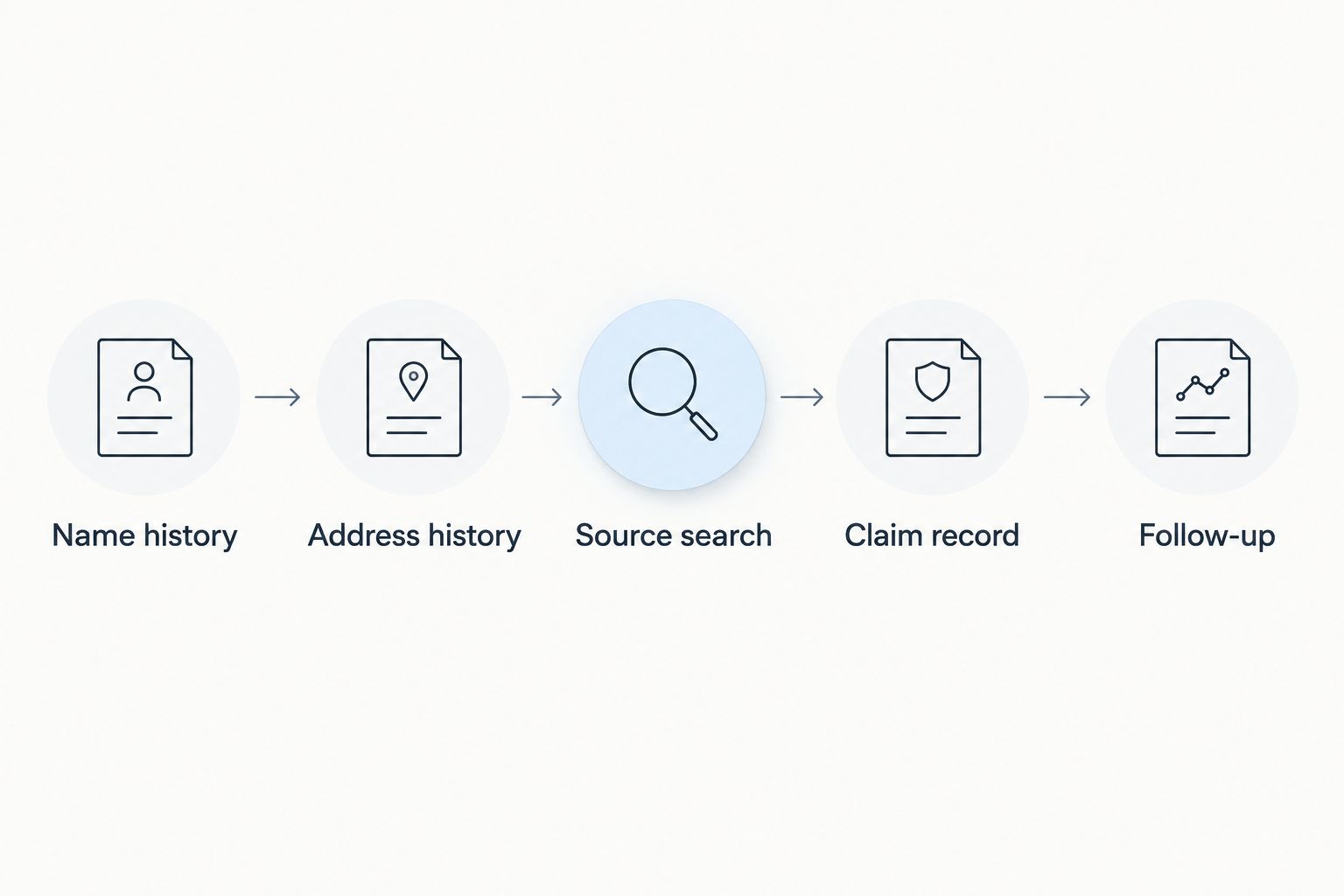
For your 2026 search, use a repeatable sequence rather than opening unrelated search boxes. Keep sensitive identity documents out of general notes and send them only through the responsible authority's verified process.
- Name history: List current and former legal names, including relevant spelling variations.
- Address history: List places where you lived, worked, or maintained accounts.
- Source search: Match each lead to state, retirement, wage, or court records.
- Claim record: Save the responsible office, reference details, and next action.
- Follow-up: Check requests and status through the official claim process.
Owedtoday is best for organizing an unclaimed money search list and tracking claims across different sources. Its role is organization; the responsible authority determines ownership and handles the official claim.
Organize your unclaimed money search
Build a personalized search list and track claims across state, federal, retirement, and court sources.
Which search tool should you choose?
Start with official state portals if you are unsure where to begin. Add MissingMoney for a participating-state sweep, then choose specialized searches only where your employment, retirement, or court history gives you a reason.
For 2026, the strongest plan is a documented search across relevant sources—not repeated searches of one database. Owedtoday supports that organization without replacing official searches or the authorities that decide claims.
FAQ
What's the best free unclaimed property search tool?
Official state unclaimed property portals are the best default for state-held money because they connect searches with the responsible claim authority. MissingMoney is useful for searching participating states together.
Does MissingMoney search every state and every type of money?
No. MissingMoney searches participating jurisdictions, not every source of unclaimed money. Check relevant state portals and specialized pension, court, or wage sources separately.
Can I search for unclaimed money without paying a service?
Yes. Official searches and official claiming are free. Use the responsible government program's instructions to search and submit your claim directly.
Is Owedtoday a government agency?
No. Owedtoday is a self-service tool that helps individuals build personalized unclaimed money search lists and track claims. The relevant authority handles the official claim and determines entitlement.
Should I search using an old name or address?
Yes. Former legal names and previous addresses can help you identify relevant records. Compare the reporting business and other details before deciding that a matching name belongs to you.
Does a matching name mean the money is mine?
No. A matching name is a lead, not proof of ownership. Follow the responsible authority's instructions and provide the evidence it requests through its verified process.
What should I do if an unclaimed money search finds nothing?
Check other relevant sources and supported name variations. A no-match result only describes the records covered by that search; it does not rule out money held elsewhere.
One last thing
Save no-match searches alongside possible matches. Record the source, name searched, and search date so you can see what you actually checked. That simple habit separates a useful search history from a folder of screenshots—and makes your next search easier to finish.