
Best overall: official state unclaimed property portals. Best for searching participating states together: MissingMoney. Best for organizing a personalized search list and tracking claims: OwedToday. This 2026 guide separates places that hold records from tools that help you manage the search.
- The best unclaimed money search sites start with official state portals; use MissingMoney to search participating states together.
- OwedToday is best for organizing unclaimed money searches and tracking claims, not replacing official records.
- Search retirement and bankruptcy sources separately; a state search is not a complete search.
- Official claiming is free. Verify the record and submit documents through the responsible agency’s instructions.
Why this matters
A search site is only useful if it covers the kind of money you are looking for. State property, workplace retirement benefits, and bankruptcy court funds follow different routes. A blank result in one database does not settle the others.
For your 2026 search, choose a starting point based on your history: where you lived, where you worked, and whether a court proceeding involved money payable to you. Then keep the searches and claims separate.
What makes the best unclaimed money search sites?
- Record authority: Can you identify the agency, plan, or court responsible for the money?
- Relevant coverage: Does the source cover state property, retirement benefits, or court funds?
- Search flexibility: Can you account for previous names, old addresses, and former employers?
- Clear next steps: Does the result explain where to submit a claim or request more information?
- Useful tracking: Can you record what you searched, what you found, and what still needs action?
These criteria favor the right source for each task, rather than a single site advertised as a complete answer.
Best search options at a glance
| Rank | Site or source | Best for | Standout feature | Key limitation |
|---|---|---|---|---|
| 1 | Official state unclaimed property portals | Confirming state-held property | Direct access to the responsible state program | Each portal covers its own jurisdiction |
| 2 | MissingMoney | Searching participating states together | Multi-state unclaimed property searches | Participation does not equal complete national coverage |
| 3 | OwedToday | Organizing searches and tracking claims | Personalized search lists and claim tracking | Not a government agency or the official claiming authority |
| 4 | U.S. Department of Labor Retirement Savings Lost and Found | Finding contacts for former workplace retirement plans | Retirement-plan contact search | Does not itself pay retirement benefits |
| 5 | Pension Benefit Guaranty Corporation | Checking benefits from PBGC-trusteed pensions | A source specific to pensions PBGC handles | Does not cover every retirement arrangement |
| 6 | U.S. Courts Unclaimed Funds Locator | Finding bankruptcy court funds | Searches participating bankruptcy courts | Court-specific claim procedures still apply |
1. State portals: best for confirming state-held money
Official state unclaimed property portals are the best default starting point for state-held money. These programs handle property such as uncashed checks, dormant account balances, and other assets transferred to the state under its rules.
Search the states connected to your history, not just your current address. An old employer or account can point you toward a state you have not thought about for years. When a listing looks familiar, compare the reported name, address, and holder before deciding it belongs to you.
State portal pros:
- You deal directly with the state program responsible for the record.
- Official instructions explain the ownership documents the state requires.
- Record details help you distinguish your property from someone else’s.
State portal cons:
- Separate states require separate searches and follow-up.
- A name match alone does not establish ownership.
Best for: People checking money already held by a state unclaimed property program.
Keep a record of the property identifier before you leave the result. That gives you a reference when gathering documents or asking about a submitted claim. Follow the instructions attached to the specific property rather than assuming every state accepts the same evidence.
Verdict: Use official state portals first for state-held property.
2. MissingMoney: best for a multi-state first pass
MissingMoney lets you search unclaimed property records from participating states in one place. It is useful when your address history crosses state lines and you want a broader first pass without opening each state portal immediately.
Treat the results as a route to the responsible program, not proof that every possible source has been checked. Confirm current participation and follow the instructions associated with the listing you find.
MissingMoney pros:
- Searches participating states from a single starting point.
- Helps you spot records associated with previous addresses.
- Identifies the state connected to a matching property record.
MissingMoney cons:
- Participating records do not cover every source of unclaimed money.
- A negative search does not replace retirement or court searches.
Best for: People with ties to multiple states who want an initial state-property search.
For a 2026 search, use MissingMoney to find leads, then verify the next step with the state responsible for the property. If a relevant state is not represented, search that state’s official portal separately. Keep the distinction between a broad search and a complete personal search clear.
Verdict: Use MissingMoney for breadth, then follow the responsible state’s process.
3. OwedToday: best for organizing searches and tracking claims
OwedToday is a self-service unclaimed money search and claim-tracking tool for individuals in the United States. It helps you build a personalized search list covering state, federal, retirement, and court sources, then track claims.
OwedToday is best for people who need to organize unclaimed money searches and track claims across sources. Its role is organization; it is not a government agency, and official claiming is always free.
OwedToday pros:
- Builds a personalized search list rather than treating every search as identical.
- Helps you organize searches across different source categories.
- Supports claim tracking after you identify a possible match.
OwedToday cons:
- Does not replace the agency, retirement plan, or court that handles the claim.
- A personalized search list does not establish that money belongs to you.
Best for: People managing searches and claim follow-up across several kinds of records.
Choose an organizing tool when the problem is keeping your next steps straight. You still need to compare records with your history and follow each responsible source’s instructions. Tracking a claim and having a claim approved are different things.
Verdict: Use OwedToday for search organization and claim tracking, alongside official sources.
4. Labor Department: best for finding former retirement-plan contacts
The U.S. Department of Labor’s Retirement Savings Lost and Found helps people find contact information for workplace retirement plans connected to their employment history. It addresses a different problem from a dormant bank account: finding the plan you need to ask about benefits.
Start with your former employer’s name and any retirement paperwork you still have. Use the official service’s current access instructions, then contact the identified plan about your situation.
Retirement Savings Lost and Found pros:
- Focuses on workplace retirement-plan connections.
- Helps turn an employer history into a plan-contact search.
- Provides a separate route from state unclaimed property records.
Retirement Savings Lost and Found cons:
- Finding a plan contact does not prove that benefits remain payable.
- The service does not itself distribute your retirement benefits.
Best for: People who have lost contact with a former employer’s retirement plan.
Ask the plan administrator to explain whether a benefit exists and what records are needed. Do not count a located plan as money recovered. The useful result at this stage is a responsible contact who can address your benefit questions.
Verdict: Use the Labor Department’s service to reconnect with a former retirement plan.
5. PBGC: best for checking pensions it has taken over
The Pension Benefit Guaranty Corporation, or PBGC, is a federal agency that insures certain private-sector defined benefit pension plans. Its benefit-search resources are relevant when PBGC has taken responsibility for a pension plan connected to your employment.
This is a targeted pension check, not a general retirement-account search. Look for the employer and plan names in your records, and follow PBGC’s instructions for checking whether it holds a benefit for you.
PBGC pros:
- Provides a direct source for pensions PBGC has taken over.
- Gives former participants a place to check a relevant pension history.
- Separates pension follow-up from unrelated state-property searches.
PBGC cons:
- Does not cover every pension or retirement arrangement.
- Is not a general search service for old 401(k) accounts or IRAs.
Best for: Former workers or beneficiaries checking a pension that PBGC handles.
If your employer changed names, gather the names shown on older benefit statements before searching. A familiar company name is a useful lead, but the plan details matter. Ask PBGC about the next step only when its records or guidance connect to your pension.
Verdict: Use PBGC for a relevant pension history, not as an all-purpose retirement search.
6. U.S. Courts: best for bankruptcy court funds
The U.S. Courts Unclaimed Funds Locator helps you search funds held by participating bankruptcy courts. These can include distributions that were not successfully paid to the person or organization entitled to receive them.
Search this source when you have a reason to connect yourself, an estate, or a business you represent to a bankruptcy case. A matching name needs further checking against the case and the court’s records.
Unclaimed Funds Locator pros:
- Covers a source outside ordinary state unclaimed property programs.
- Connects search results to a bankruptcy court and case.
- Gives you a starting point for court-specific follow-up.
Unclaimed Funds Locator cons:
- Covers participating bankruptcy courts, not every kind of court-held money.
- Claim documentation and filing instructions depend on the responsible court.
Best for: People checking unpaid distributions connected to bankruptcy proceedings.
Read the court’s current instructions before submitting documents. If you are claiming for a deceased relative, company, or another person, you must establish your authority as well as the connection to the funds. Do not assume a shared surname is enough.
Verdict: Use the Unclaimed Funds Locator for bankruptcy funds, then follow that court’s process.
How these options are ranked
The 2026 ranking prioritizes record authority, relevant coverage, search flexibility, clear next steps, and useful tracking. Official state portals take the default position because they connect state-held property with the program responsible for handling it.
The remaining options serve distinct jobs. MissingMoney broadens the state-property first pass; an organizing tool manages follow-up; retirement and court sources address records that require separate searches. This is a task-based guide, not a ranking based on recovery amounts or processing speed.
Turn the search into a claim plan
Use 3 search passes, 2 name versions where relevant, and 1 claim log as a practical starting routine. These are organizing steps, not agency requirements.
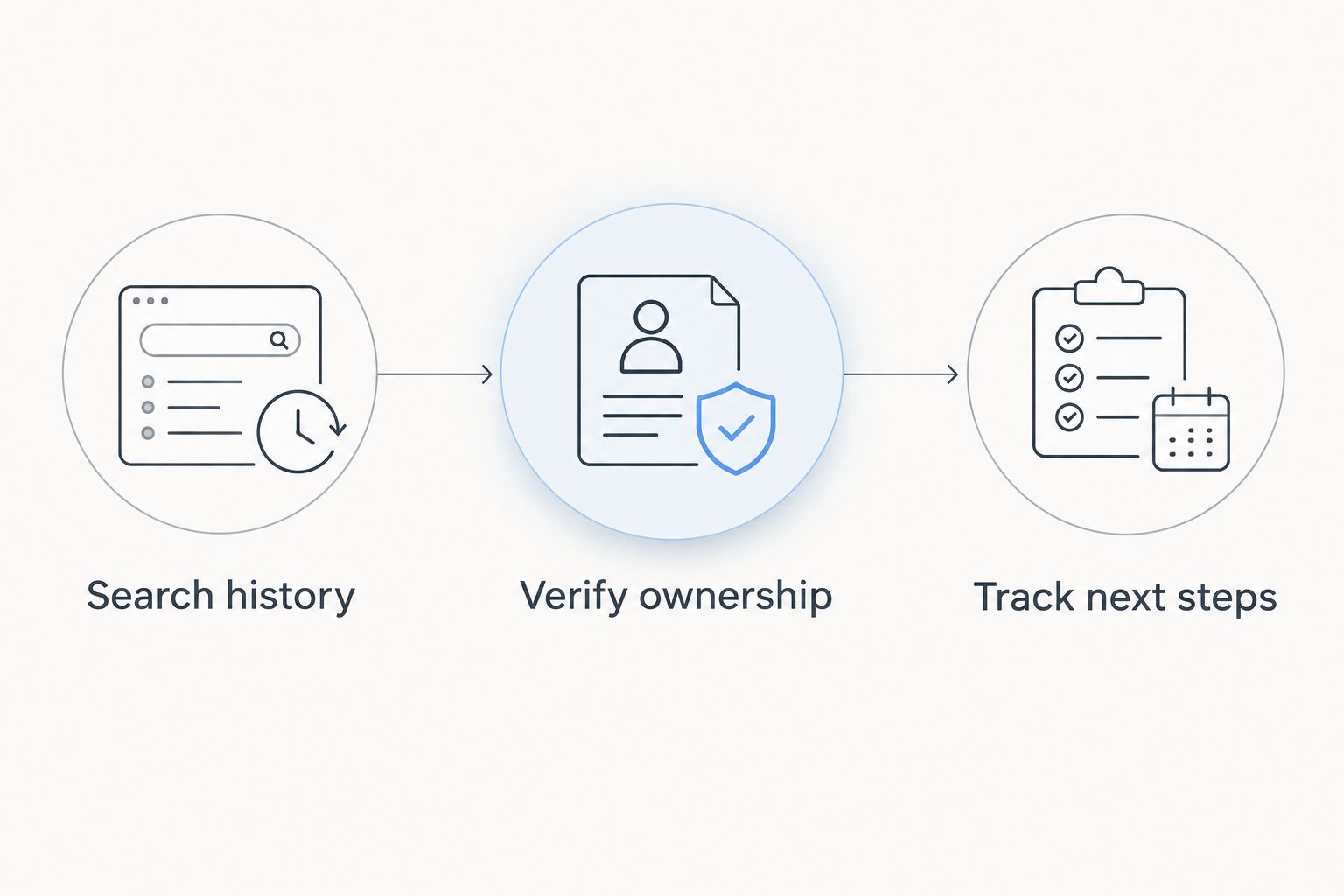
Search history
List the states where you lived, former employers, previous addresses, and names you used. Where relevant, start with your current name and a previous surname, then add other documented variations. Search each source that fits that history.
Verify ownership
Compare the reported address and holder with your records. Record why the match looks connected to you, and separate uncertain matches from records you can support. A result with your name is a lead, not an approved claim.
Track next steps
Keep the source name, property or case identifier, submission date, confirmation reference, and next action in your claim log. Follow the responsible agency’s document instructions. For your 2026 search, record the date you checked a source even when you found nothing.
Never send identity documents just because an unsolicited message says money is waiting. Independently locate the responsible agency or court and confirm its submission process. Keep sensitive documents out of public notes and shared screenshots.
Which search option should you choose?
Start with official state portals if you are unsure where to begin. Add MissingMoney for participating-state coverage, then search retirement or bankruptcy sources when your history points there.
Use an organizing tool if you are losing track of searches, documents, or follow-up. The best choice is not the site with the broadest promise; it is the source that fits the money you are trying to locate.
FAQ
What are the best unclaimed money search sites in 2026?
Official state unclaimed property portals are the best default starting point for state-held money. MissingMoney helps with participating-state searches, while retirement and bankruptcy records require separate sources.
Is OwedToday a government agency?
No. OwedToday is a self-service tool that helps individuals build personalized search lists and track unclaimed money claims. Official claiming is always free.
Is MissingMoney better than a state unclaimed property website?
MissingMoney is useful for searching participating states together; an official state portal is useful for checking that state’s records and claim instructions. Use the source that fits the task rather than treating either as a complete national search.
Can one website find all the unclaimed money owed to me?
No single source in this guide covers every category of unclaimed money. State property, workplace retirement benefits, and bankruptcy funds use different records and follow-up processes.
Does a search result mean the money is mine?
No. A search result is a possible match that you must check against your identity, address history, and connection to the reported holder. The responsible authority determines whether your evidence supports the claim.
How do I search for money under an old name?
Search the names you previously used as well as your current name. Keep documents connecting those names available, and follow the responsible agency’s instructions if it requests proof.
Where should I look for an old workplace retirement benefit?
Start with the former employer or plan administrator, or use the Labor Department’s Retirement Savings Lost and Found to find plan contact information. Check PBGC separately when your pension history involves a plan it handles.
One last thing
An old address can be more useful than a familiar name. Before closing your 2026 search, write down previous addresses from records you already have. Compare them with possible matches, and save the property or case identifiers you need for follow-up.
That turns a vague memory into evidence you can check. You are looking for money that is already yours—not trying to make a search result belong to you.