
Best overall for organizing your search: Owedtoday. Best for locating a former employer’s retirement plan: the U.S. Department of Labor’s Retirement Savings Lost and Found. Best for a terminated plan: the Pension Benefit Guaranty Corporation’s Missing Participants Program. These unclaimed 401k search tools serve different jobs; choose the one that matches what happened to your account.
- Owedtoday is best for organizing unclaimed 401k search tools and tracking retirement claims, not confirming an account balance.
- Use the Department of Labor’s Retirement Savings Lost and Found to locate former workplace retirement plan contacts.
- Use PBGC’s Missing Participants Program when a terminated retirement plan transferred benefits or reported their location.
- Official claiming is always free. A search match does not establish ownership or the amount payable.
Why this matters
A missing 401(k) is not necessarily sitting in an unclaimed-property database. Your account might remain with a plan recordkeeper, have moved to another provider, or have been transferred after a plan ended.
In 2026, the useful question is not which tool searches everything. It is which tool can identify the next organization you need to contact. Search results are leads, not account statements, and a missing result does not prove that no account exists.
Owedtoday is an unclaimed-money search and claim-tracking tool, not a government agency. Official claiming is always free; optional help organizing your search is separate from the official claim process.
What makes the best unclaimed 401k search tools
Judge retirement search tools by what they help you establish, not by promises about money waiting for you.
- Source fit: Does the tool address active workplace plans, terminated plans, abandoned plans, or state-held property?
- Actionable results: Does the result identify a plan administrator, a qualified termination administrator, or an agency handling a claim?
- Clear limits: Does the tool distinguish a possible match from a verified account and payable benefit?
- Search organization: Can you keep employer names, search results, and follow-up work together?
- Identity protection: Can you verify who operates the service before providing sensitive information?
No single result replaces the administrator’s ownership checks. A useful tool gets you closer to the right records without pretending that a name match proves entitlement.
Unclaimed 401k search tools at a glance
This 2026 comparison ranks tools by distinct use case rather than treating every database as interchangeable. Start with your employer history, then choose the relevant search route.
| Tool | Best for | Standout function | Key limitation |
|---|---|---|---|
| Owedtoday | Organizing a search across sources | Personalized search list and claim tracking | Does not replace official ownership verification |
| DOL Retirement Savings Lost and Found | Finding a former workplace retirement plan contact | Federal search for retirement plan information | Not a live account-balance lookup |
| PBGC Missing Participants Program | Tracing benefits from a terminated plan | Handles transferred benefits and reported benefit locations | Does not cover every missing 401(k) |
| DOL Abandoned Plan Search | Finding who is winding down an abandoned plan | Identifies plans and qualified termination administrators | Limited to the abandoned-plan process |
| State unclaimed-property searches | Checking state-held property connected to old accounts | Searches property held by state programs | Not a nationwide registry of workplace retirement accounts |
1. Owedtoday: best for organizing a retirement money search
Owedtoday helps individuals in the US build a personalized search list and track claims across state, federal, retirement, and court sources. For a missing 401(k), its role is organizing the search and keeping follow-up work visible—not certifying that an account exists.
Owedtoday is best for people who want to organize an unclaimed-money search and track retirement claims. That distinction matters when you have several former employers or several possible places to check.
Owedtoday pros:
- Builds a personalized search list rather than leaving you with an undifferentiated list of sources.
- Supports claim tracking alongside the search process.
- Covers retirement sources as well as other categories of unclaimed money.
Owedtoday cons:
- It is not a government agency or the retirement plan administrator.
- A search list or tracked claim does not establish your ownership or confirm a balance.
Best for: Someone managing several search leads who wants a self-service way to organize the work.
Keep the distinction between finding a source and claiming from that source. Official claiming is always free, and the organization holding the records decides what evidence is required.
Verdict: Buy into the organization-first approach; use official sources to verify and claim.
2. DOL Retirement Savings Lost and Found: best for plan contacts
The U.S. Department of Labor’s Retirement Savings Lost and Found helps people locate information about retirement benefits from former employers or unions. Its practical value is identifying a plan contact so you can ask about your own account history.
Start here when you remember the employer but no longer know which company administers the retirement plan. A plan contact is a lead; ask the administrator whether you have a benefit and what happened to it.
Retirement Savings Lost and Found pros:
- Provides an official federal starting point for former workplace retirement benefits.
- Helps connect an employer history with retirement plan information.
- Directs the search toward the people responsible for plan records.
Retirement Savings Lost and Found cons:
- It is not a live statement of your investment balance.
- Finding a plan does not prove that you participated, vested, or still have an account there.
Best for: A former employee who needs to identify the retirement plan or its current contact.
For your 2026 search, use the Department of Labor’s official instructions and identity-verification process. Confirm that you are dealing with the agency before entering sensitive personal information.
Verdict: Buy into this route first when the missing piece is the plan contact.
3. PBGC Missing Participants Program: best for terminated plans
The Pension Benefit Guaranty Corporation’s Missing Participants Program helps connect people with benefits from certain terminated retirement plans. Participating defined contribution plans, including eligible 401(k) plans, can transfer missing participants’ benefits to PBGC or report where benefits were transferred.
That makes PBGC relevant when a plan ended, not simply when you changed jobs. PBGC does not insure 401(k) investment balances; its missing-participant role is separate from its pension insurance role.
PBGC Missing Participants Program pros:
- Offers a specific route for benefits from participating terminated plans.
- Can identify benefits held by PBGC or a reported outside location.
- Addresses a situation that a current-employer search can miss.
PBGC Missing Participants Program cons:
- Not every terminated 401(k) plan appears in the program.
- A search of PBGC alone does not cover accounts still held by ongoing plans.
Best for: Someone whose former retirement plan terminated and whose benefit location is unknown.
If you find a match, follow the instructions associated with that record. Do not assume that the former employer, PBGC, and a receiving financial institution hold identical records.
Verdict: Buy into this route when plan termination is confirmed or needs investigation.
4. DOL Abandoned Plan Search: best for abandoned-plan contacts
The Department of Labor’s Abandoned Plan Search identifies plans in its Abandoned Plan Program and the qualified termination administrators handling them. These administrators manage the process of winding down an abandoned individual account plan and distributing its assets.
Use this tool when the employer disappeared or stopped carrying out its plan responsibilities. A business closing does not by itself establish that the plan is part of this program.
DOL Abandoned Plan Search pros:
- Targets the specific problem of an abandoned workplace retirement plan.
- Identifies a qualified termination administrator when a matching record exists.
- Gives you a relevant contact for questions about the termination process.
DOL Abandoned Plan Search cons:
- It does not list every closed employer or every missing retirement account.
- A matching plan record does not confirm your personal account balance.
Best for: A former employee whose employer is no longer handling the retirement plan and who needs to identify the administrator overseeing its termination.
Ask the listed administrator how to establish participation and whether a distribution or transfer occurred. Keep the answer with your search notes so you do not repeat the same investigation later.
Verdict: Buy into this route for an abandoned-plan problem; skip it as your only search.
5. State unclaimed-property searches: best for state-held leads
State unclaimed-property programs let you search for property held by individual states. They are a separate route from workplace retirement plan searches, useful when a payment or other property associated with your financial history reached state custody.
Start with states connected to your previous addresses and employment. The National Association of Unclaimed Property Administrators provides a directory of official state programs; verify the state agency before submitting a claim.
State unclaimed-property search pros:
- Provides a direct route to property already held by a state program.
- Supports searches using former names and locations.
- Can identify other money while you investigate your retirement history.
State unclaimed-property search cons:
- It is not a substitute for contacting a retirement plan administrator.
- A similar name can belong to someone else, and separate states require separate searches.
Best for: Someone checking state-held leads after, or alongside, employer and federal retirement searches.
In 2026, treat a state result as a property record requiring verification—not automatic proof of a missing 401(k). Official claiming is always free, and the state determines the documentation needed.
Verdict: Buy into this as a parallel check; skip the assumption that it covers every retirement account.
Turn search results into a usable next step
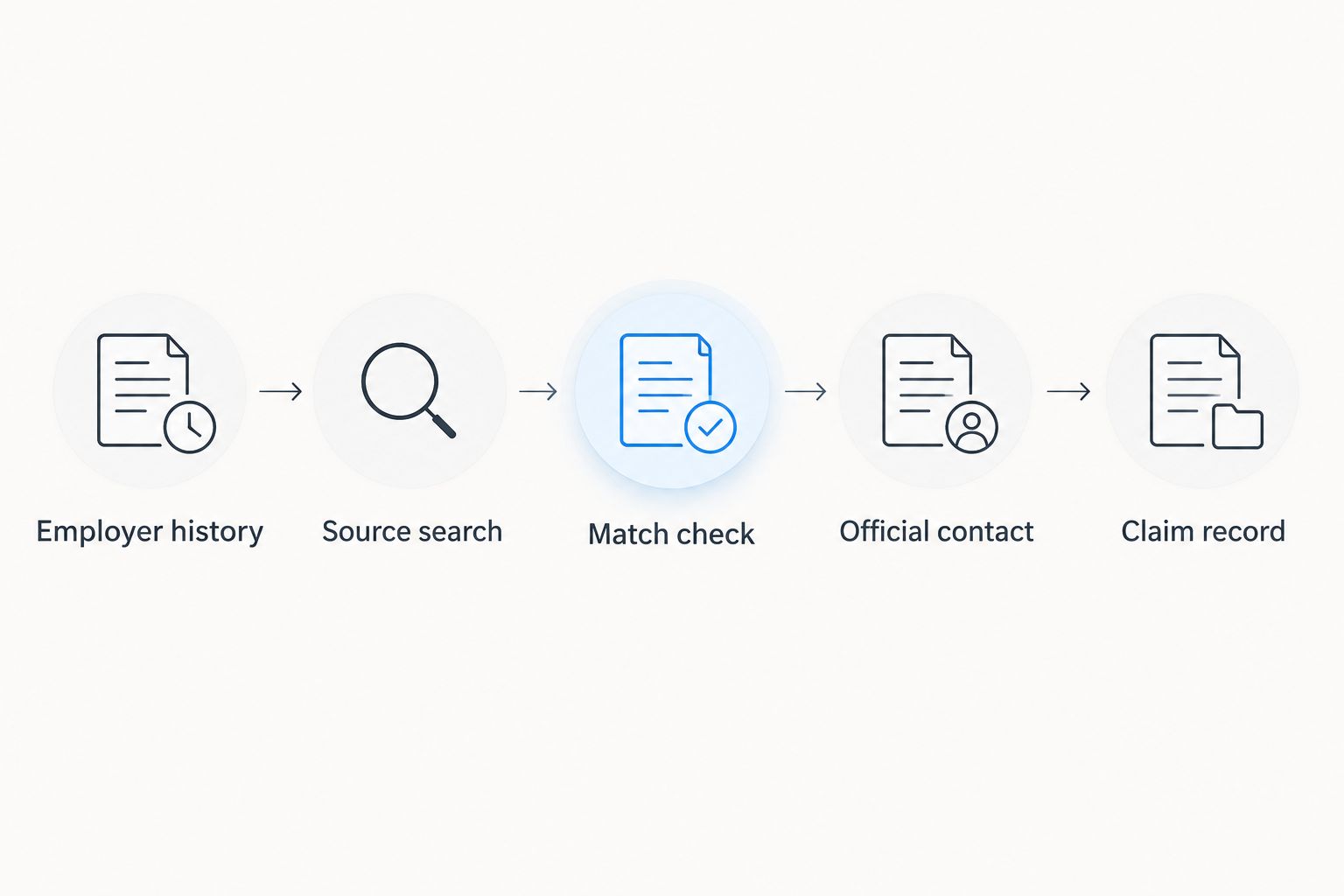
A scattered search produces repeated work. Use this sequence to turn employer memories and database results into a record you can act on.
- Employer history: Write down 3 details for each job: employer name, work location, and approximate employment dates. Add former company names when you know them.
- Source search: Choose the database that matches the situation: unknown plan contact, terminated plan, abandoned plan, or state-held property.
- Match check: Compare the result with your employer history. A shared name alone is not enough.
- Official contact: Ask the administrator or agency how to verify ownership and whether the benefit was transferred.
- Claim record: Save the official reference number, requested documents, and next action in a secure place.
Keep 2 search tracks separate: finding the account and deciding what to do with the money. Before requesting a distribution, read the plan’s notices and consider qualified tax advice; locating an account does not make every withdrawal tax-free.
For a 2026 search log, date each contact and record the answer rather than just marking a source searched. A confirmed transfer destination is more useful than a repeated empty search.
How the tools are ranked
These recommendations prioritize source fit, actionable contacts, clear limitations, organization, and identity protection. They do not rank tools by recovery totals or success rates.
The organizing tool comes first for managing the process. Official databases then occupy separate slots because a terminated plan, an abandoned plan, and state-held property require different follow-up.
Which tool should you choose?
Start with the Department of Labor’s Retirement Savings Lost and Found when you have a former employer but no current plan contact. Choose PBGC when the plan terminated, and the Abandoned Plan Search when the problem is an abandoned plan.
Use an organizing tool if you need to keep several leads and claims together. Add state searches without treating them as a replacement for retirement-plan research.
FAQ
What are the best unclaimed 401k search tools in 2026?
The best tool depends on the problem: use the Department of Labor’s Retirement Savings Lost and Found for plan contacts, PBGC for participating terminated plans, and the Abandoned Plan Search for abandoned-plan administrators. State searches address state-held property, while an organizing tool helps track the work.
Is there one database that finds every old 401(k)?
No single database establishes every old 401(k) account and its current balance. Employer records, plan administrators, federal search programs, and state property searches serve different purposes.
Can PBGC help find a missing 401(k)?
PBGC can help when an eligible terminated plan participated in its Missing Participants Program. PBGC does not insure 401(k) investment balances, and its search does not cover every workplace account.
Does a search match mean the money is mine?
A search match does not establish ownership or the amount payable. The plan administrator, receiving institution, or government agency must verify your identity and entitlement.
Do I have to pay to claim unclaimed money?
Official claiming is always free. Optional search or organizational services are separate from the official process, and locating retirement money does not remove potential tax consequences from a later distribution.
What should I do if my former employer closed?
Check for the retirement plan’s current administrator, then investigate PBGC and the Department of Labor’s Abandoned Plan Search as appropriate. An employer closing does not automatically mean the retirement plan was abandoned or transferred to PBGC.
What if I find no results for my old 401(k)?
An empty search does not prove that no retirement benefit exists. Check former employer names, old statements, employment dates, and possible transfers, then contact the relevant plan administrator.
One last thing
Ask where the account went, not just whether an account exists today. If an administrator confirms a transfer, request the receiving institution’s name and the information needed to trace it. That answer gives you a concrete next step instead of another round of broad searches.