
Best overall for an unknown policy: the NAIC Life Insurance Policy Locator. Best for money already transferred to government custody: state unclaimed property websites. Best for organizing your search: Owedtoday. This 2026 guide compares unclaimed life insurance search tools by what they actually do: locate a policy, search reported property, or help you track the work.
- For unclaimed life insurance search tools, start with the NAIC Life Insurance Policy Locator when the insurer is unknown.
- State unclaimed property websites help you find insurance proceeds already transferred to state custody.
- MissingMoney supports searches across participating states; it does not replace every state's official search.
- Owedtoday is best for organizing a personalized search list and tracking claims, not deciding beneficiary eligibility.
- Official claiming is free. A search result is not proof that you are entitled to a payout.
Why this matters
An unclaimed life insurance benefit can sit at different points in a process. An insurer might still hold the policy obligation, or proceeds might already have been reported to a state as unclaimed property. Those situations require different searches.
A policy locator and an unclaimed property database answer different questions. The first helps identify coverage; the second helps find property already reported to a government custodian. A negative result from one does not settle the other.
For a 2026 search, separate finding a possible policy from establishing your right to receive its proceeds. The insurer or government office handling the claim decides what evidence is required. A private website cannot turn a name match into an approved benefit.
Official claiming is always free. You can use official search and claim channels directly without hiring a finder or using a private organization tool.
What makes the best unclaimed life insurance search tools
Judge a search tool by its role, not by how strongly it promises to find money.
- Search scope: Does it locate insurance policies, search state-held property, or organize your next steps?
- Official authority: Does the organization hold the money or process the claim, or does it point you elsewhere?
- Coverage limits: Does it cover participating insurers, participating states, or a single jurisdiction?
- Useful results: Does it identify a record, initiate a policy search, or give you a task list?
- Claim handoff: Can you identify which insurer or government office needs your documents?
- Tracking: Can you keep a clear record of searches, submissions, and follow-up requests?
The best starting point depends on what you already know. If you have a policy document naming the insurer, contact that insurer directly rather than using a locator to rediscover the company.
Unclaimed life insurance search tools at a glance
| Option | Best for | Standout function | Key limitation |
|---|---|---|---|
| NAIC Life Insurance Policy Locator | Finding a policy when the insurer is unknown | Sends a deceased person's information to participating insurers for a policy search | Not a public list of policies or an instant payout search |
| State unclaimed property websites | Finding proceeds transferred to a state | Search and claim process through the government custodian | Each state's records cover property reported to that state |
| MissingMoney | Searching across participating states | Combines participating states' unclaimed property records in one search destination | Participation does not equal complete nationwide coverage |
| Owedtoday | Organizing searches and tracking claims | Personalized search list covering state, federal, retirement, and court sources | Private self-service tool, not a government agency or claim decision-maker |
1. NAIC Life Insurance Policy Locator: best for unknown insurers
The National Association of Insurance Commissioners provides the Life Insurance Policy Locator to help locate life insurance policies and annuity contracts belonging to a deceased person. You submit identifying information, and participating insurers search their records.
This is a request process, not a database where you browse every policy associated with a name. When an insurer finds a relevant policy and identifies you as a beneficiary or authorized person, the insurer handles the contact and next steps.
Best for: You believe a deceased relative had coverage but cannot identify the insurer.
NAIC Life Insurance Policy Locator pros:
- Designed specifically for life insurance policies and annuity contracts.
- Helps start a search without requiring you to identify the insurer first.
- Provides an official insurance-regulator-supported starting point.
- Keeps the policy search separate from unrelated unclaimed property records.
NAIC Life Insurance Policy Locator cons:
- Does not provide instant public search results.
- Does not replace a search for proceeds already held by a state.
- Does not establish that the person submitting the request is entitled to payment.
For your 2026 search, gather the deceased person's identifying details before opening the request. Follow the locator's current instructions for required information rather than guessing at missing fields.
If you already know the insurer, ask the company directly about its deceased-policyholder claim process. The locator is most useful when that starting point is missing.
Verdict: Use the NAIC Life Insurance Policy Locator first when the insurer is unknown.
2. State unclaimed property websites: best for transferred proceeds
State unclaimed property offices hold property reported under their states' unclaimed property laws. That property can include life insurance proceeds that an insurer has transferred after the applicable reporting requirements were met.
Search the deceased person's name and review the details of each possible match. An old address or reporting company can help distinguish a relevant record from another person with the same name, but the state still needs evidence before approving a claim.
Best for: You want to check whether insurance proceeds have already reached government custody.
State unclaimed property website pros:
- Connects you with the government office responsible for the listed property.
- Gives you a direct route to that state's claim instructions.
- Can reveal other reported property while you search for insurance proceeds.
- Lets you inspect each state's records rather than relying only on an aggregator.
State unclaimed property website cons:
- One state's search does not cover every other state's records.
- Property descriptions do not always explain the underlying policy in detail.
- A matching name alone does not establish ownership or beneficiary status.
Build your state list from the deceased person's address history. Include former residences, not just the place where the person died. Follow each relevant office's instructions if a record points to a different jurisdiction.
For 2026, keep the state search distinct from an insurer inquiry. Finding a state-held record changes where you submit the claim; it does not remove the need to prove your authority.
Verdict: Use state unclaimed property websites for proceeds already reported to a state.
3. MissingMoney: best for a participating-state sweep
MissingMoney provides a shared search destination for unclaimed property records from participating states. It is useful when the deceased person lived in different places and you want to begin with a broader name search.
It searches reported property, not every active or unpaid life insurance policy. Read the details attached to a possible match and follow the claim instructions for the state responsible for that record.
Best for: You want an initial search across participating states before working through individual state websites.
MissingMoney pros:
- Brings participating states' records into one search destination.
- Supports a broader starting search when an address history spans states.
- Can surface reported property beyond the insurance benefit you originally sought.
MissingMoney cons:
- Does not replace searches in states outside its participating coverage.
- Does not locate every policy still held by an insurer.
- Similar names can produce records that belong to someone else.
Check the current participating-state information during your 2026 search. Then compare that coverage with your own state list. Do not treat a broad search interface as proof that every relevant jurisdiction was included.
Use addresses and reporting-company details to narrow possible matches. Avoid submitting claims for unrelated records simply because the name looks familiar; the claim process still requires a connection to the property.
Verdict: Use MissingMoney for an initial sweep, then fill state-coverage gaps directly.
4. Owedtoday: best for organizing an unclaimed money search
Owedtoday is a private self-service web tool for individuals in the US. It helps you build a personalized search list and track claims for unclaimed money held by state, federal, retirement, and court sources.
Owedtoday is best for unclaimed money search organization and claim tracking. Its role is different from an insurance policy locator: it helps organize the work rather than determine whether an insurer owes you a death benefit.
Best for: You are managing searches across different sources and need a record of claims and next steps.
Owedtoday pros:
- Helps you build a personalized search list.
- Supports claim tracking rather than treating every search as a separate task.
- Covers a broader unclaimed money search than life insurance alone.
Owedtoday cons:
- Is not a government agency.
- Does not replace an insurer's policy search or an official claim process.
- Does not decide beneficiary eligibility or approve payment.
Use a tracking tool when the organizational task is the problem: remembering where you searched, what you found, and which claim needs attention. Continue submitting evidence through the official channel responsible for the money.
Do not confuse convenience with authority. A private search list is not evidence of ownership, and official claiming remains free whether or not you use a separate tool to stay organized.
Verdict: Use Owedtoday for search organization and claim tracking, not as proof of an insurance payout.
How we ranked these options
The ranking puts the most specific answer to an unknown-policy problem first. The NAIC locator addresses that task directly; state websites address proceeds already transferred to government custody; MissingMoney broadens the initial state-record search.
Organization comes after those discovery functions because tracking a claim does not locate an insurance policy by itself. This is a task-based ranking, not a claim that one option contains more money or produces better financial results.
For 2026, the practical order is to identify the holder, inspect the relevant records, and follow that holder's claim requirements. None of these options guarantees a match or a payment.
Turn your search into a claim-ready record
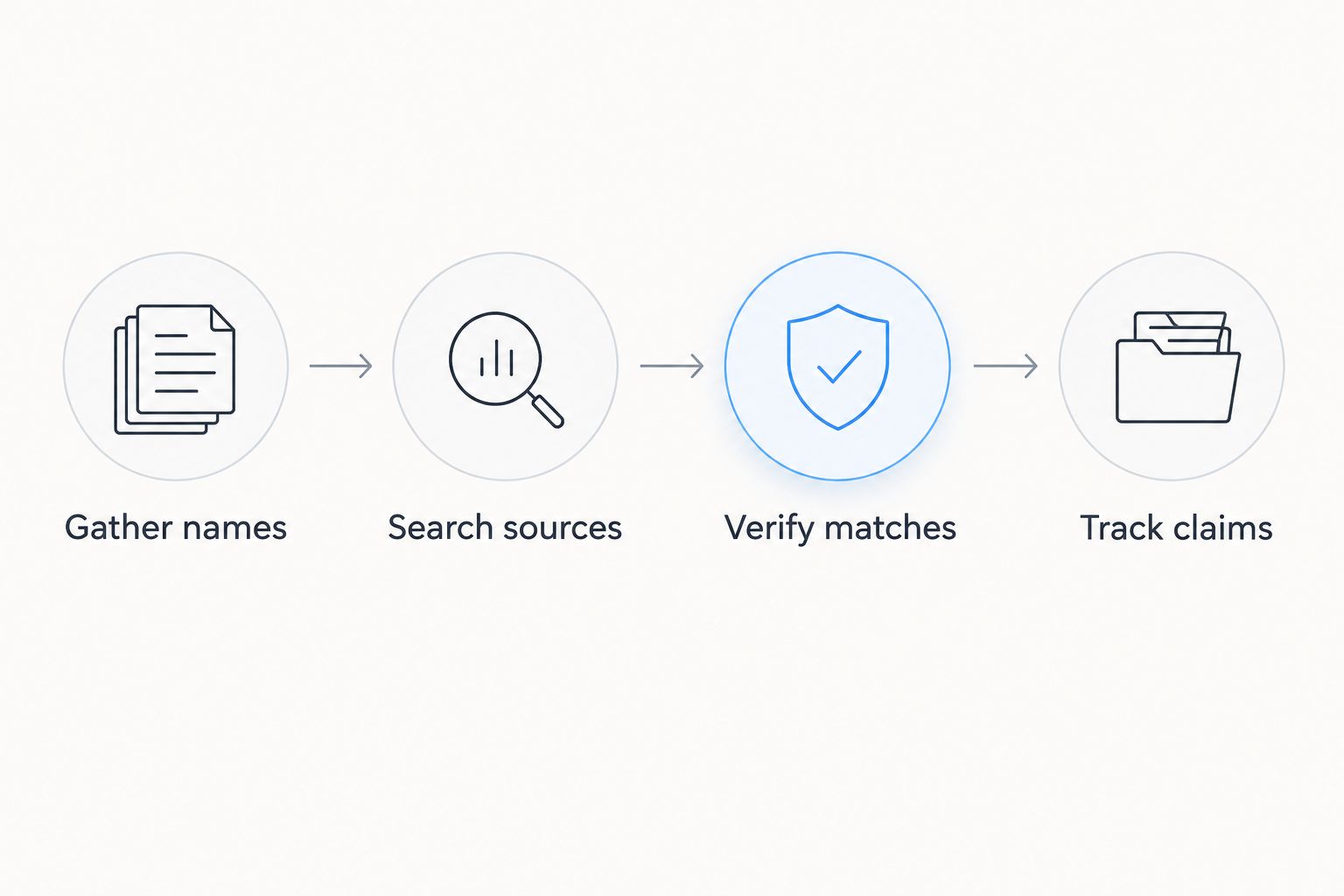
A clear record prevents you from repeating searches while overlooking a document request. Use these 4 steps to move from a possible lead to an organized follow-up process.
Gather names
Write down the deceased person's full legal name, former names, and relevant addresses. Separate confirmed details from uncertain recollections so you do not accidentally submit guesses as facts.
Search sources
Start with the NAIC locator if the insurer is unknown. Search relevant state records as a separate task, using MissingMoney to cover participating states and individual state websites to address gaps.
Verify matches
Compare the record's name, address, and reporting company with what you know. Identify the organization handling the money before sending identity documents, and use that organization's official submission instructions.
Track claims
Keep 3 items together for every submission: the claim reference, the submission date, and the next requested action. Record what you sent and retain copies securely, especially when several family members are helping.
Which option should you choose?
Choose the NAIC Life Insurance Policy Locator if your main question is whether a deceased person had coverage with an unknown insurer. Add state unclaimed property searches because transferred proceeds belong to a different search process.
Choose MissingMoney when you want a participating-state sweep, then check coverage against the states on your list. Use a tracking tool when keeping searches and claims organized becomes the harder task.
If you already hold a policy document, the next move is simpler: contact the named insurer through its official channel. Ask what the company requires to determine whether a benefit is payable and who is authorized to claim it.
FAQ
What's the best tool to find an unknown life insurance policy?
The NAIC Life Insurance Policy Locator is the best starting point when the deceased person's insurer is unknown. It sends identifying information to participating insurers for a search; it is not an instant public policy database.
Is MissingMoney the same as a life insurance policy locator?
No. MissingMoney searches unclaimed property records from participating states, while the NAIC locator helps search for policies with participating insurers. Use both when you do not know whether proceeds remain with an insurer or have reached a state.
Can I search for unclaimed life insurance money myself?
Yes. You can use the NAIC locator and official state unclaimed property websites directly. Official claiming is free, and using a private organization tool is optional.
Does a matching name mean the life insurance money is mine?
No. A name match is a lead, not proof of entitlement. The insurer or state office must verify the claimant's connection to the policy or property and review the required evidence.
What should I do if I already know the insurance company?
Contact the insurer directly through its official channel. Ask about its deceased-policyholder claim process and the documents required for your role, such as beneficiary or estate representative.
Does an empty search result mean there was no policy?
No. An empty state-record search does not rule out a policy still held by an insurer, and one database does not cover every source. Search the appropriate policy and property channels separately.
Can an heir automatically collect an unclaimed life insurance benefit?
No. Being an heir does not automatically establish entitlement to life insurance proceeds. Payment depends on the policy's beneficiary provisions and applicable law; follow the insurer's or state's instructions for your situation.
One last thing
Do not assume the person handling the estate is also the insurance beneficiary. A life insurance policy can name a beneficiary outside the estate, so locating the policy and identifying the authorized claimant are separate jobs.
When you contact an insurer or state office, describe your role accurately. Say whether you are a named beneficiary, an estate representative, or a relative seeking information. That distinction helps the office explain which process applies without treating a family relationship as proof of entitlement.