
Best overall: IRS Where’s My Refund? Best for missing tax records: IRS Get Transcript. Best for organizing a broader search: Owedtoday. This 2026 guide compares unclaimed IRS tax refund search tools by the problem they solve: tracking a filed return, finding records for an unfiled return, or tracing a payment that never arrived.
- IRS Where’s My Refund? is the best starting point among unclaimed IRS tax refund search tools for filed returns.
- IRS Get Transcript helps recover tax records; it does not calculate or claim an unfiled refund.
- Owedtoday helps organize unclaimed money searches and claim tracking; it is not a government agency.
- Official claiming is always free. A search result does not establish that you qualify for a refund.
Why this matters
An unfiled tax return, a refund still being processed, and a missing refund check require different actions. A general unclaimed-money search does not replace the IRS process for any of them. First identify where your refund stopped.
For a broader search, Owedtoday helps individuals build a personalized search list and track claims across state, federal, retirement, and court sources. Owedtoday is not a government agency, and official claiming is always free. Its role is organization—not deciding whether the IRS owes you a refund.
In 2026, keep the tax year separate from the year you search. A refund belongs to a particular return, and the filing deadline depends on that return’s circumstances. Do not treat the date you discovered a possible refund as the start of your claim period.
What makes the best IRS refund search tool?
Choose a tool by its job, not by whether its name promises to find money.
- Direct relevance: Does it track a filed refund, provide records, or address a missing payment?
- Official authority: Can it show IRS information or initiate an IRS process?
- Clear requirements: Does it explain which return details or identity checks you need?
- Useful next steps: Does the result tell you what to do next?
- Honest limits: Does it distinguish searching, preparing a return, and claiming a refund?
For this 2026 comparison, direct IRS access takes priority for tax-refund questions. Search organization matters when you are checking several sources, but it cannot replace filing a required return or responding to an IRS notice.
Unclaimed IRS tax refund search tools at a glance
| Rank and option | Best for | Standout function | Key limitation |
|---|---|---|---|
| 1. IRS Where’s My Refund? | Tracking a filed return | Shows refund-processing status | Does not uncover refunds from unfiled returns |
| 2. IRS Get Transcript | Recovering missing tax records | Provides available IRS transcripts | Records alone do not establish a refund |
| 3. IRS Individual Online Account | Reviewing account context | Brings together tax-account information and available notices | Does not replace filing a missing return |
| 4. IRS Refund Inquiries | Tracing an issued payment | Provides instructions for missing refunds and refund traces | Not a search for unknown refunds |
| 5. Owedtoday | Organizing a broader unclaimed-money search | Personalized search lists and claim tracking | Not an official IRS refund-status service |
1. IRS Where’s My Refund?: best for filed-return tracking
IRS Where’s My Refund? is the strongest starting point when you already filed and want to know what happened to the refund. It reports the return’s refund status rather than searching for money attached to every version of your name.
You need 3 matching details: your Social Security number or individual taxpayer identification number, filing status, and exact refund amount from the return. Use the amount shown on the return you filed, not an estimate from an earlier draft.
IRS Where’s My Refund? pros:
- Answers the immediate question about a filed refund.
- Uses IRS processing information.
- Shows progress through return receipt, refund approval, and payment issuance.
IRS Where’s My Refund? cons:
- Does not calculate a refund for an unfiled return.
- Requires return details rather than just a name.
Best for: You filed a return and need its refund status.
Verdict: Use IRS Where’s My Refund? first for a filed return. If the result gives instructions, follow those instructions before starting an unrelated unclaimed-property search.
2. IRS Get Transcript: best for missing tax records
IRS Get Transcript helps when missing records are blocking your next step. Different transcripts serve different purposes: a wage and income transcript shows information reported to the IRS, while a tax account transcript shows account activity such as payments and adjustments.
Choose the transcript type that matches the question. A wage and income transcript can help reconstruct income records, but it is not a finished tax return and does not necessarily contain everything needed to prepare one.
IRS Get Transcript pros:
- Provides access to available IRS tax records.
- Helps distinguish reported income from account activity.
- Supports preparation when original documents are missing.
IRS Get Transcript cons:
- Does not determine refund eligibility by itself.
- Does not replace all supporting documents needed for a return.
Best for: You need records before preparing an overdue return or investigating account activity.
Verdict: Use IRS Get Transcript for evidence, not a promised refund. In 2026, request the relevant tax year and transcript type rather than assuming the newest document answers an older question.
3. IRS Individual Online Account: best for account context
IRS Individual Online Account helps you review your tax situation beyond a single refund-status message. It provides tax-account information, payment history, and access to available digital notices and records.
This is useful when you need to connect a payment, an account balance, or an IRS notice to the return you are investigating. Read the notice itself before deciding what action to take; a balance or transaction needs context.
IRS Individual Online Account pros:
- Brings related account information into one place.
- Helps you review recorded payments.
- Provides access to available IRS notices and tax records.
IRS Individual Online Account cons:
- Requires identity verification for access.
- Account information does not replace preparing an unfiled return.
Best for: You need to understand account activity or a notice alongside a refund question.
Verdict: Use IRS Individual Online Account when status alone is not enough. For a straightforward question about whether a filed refund has been issued, start with Where’s My Refund? instead.
4. IRS Refund Inquiries: best for a missing issued payment
IRS Refund Inquiries provides official instructions when a refund appears to have been issued but you did not receive it. Depending on the circumstances, the next step is a refund trace rather than another search.
An issued paper check that never arrived and a direct deposit that did not reach the expected account are payment problems. Follow the IRS instructions for your situation, including any waiting period or direction to contact your financial institution.
IRS Refund Inquiries pros:
- Addresses missing payments after issuance.
- Explains the refund-trace process.
- Distinguishes payment-delivery problems from return processing.
IRS Refund Inquiries cons:
- Does not find refunds from unfiled returns.
- Requires you to follow the applicable timing and contact instructions.
Best for: IRS status shows an issued refund, but you have not received the money.
Verdict: Use IRS Refund Inquiries for a missing payment, not a pending return. Form 3911 is used in refund-trace situations; follow the IRS instructions before submitting it.
5. Owedtoday: best for organizing a broader search
Owedtoday is an unclaimed money search and claim-tracking tool for individuals in the US. It helps you build a personalized search list across state, federal, retirement, and court sources, rather than treating every possible claim as an IRS refund.
That distinction matters when your search extends beyond taxes. Keep the source, next action, and claim status clear so a retirement lead does not get mixed up with a tax-return question.
Owedtoday pros:
- Helps build a personalized search list.
- Supports claim tracking.
- Covers multiple categories of unclaimed-money sources.
Owedtoday cons:
- Is not a government agency.
- Does not replace the official process for establishing and claiming a refund.
Best for: You want to organize a wider search alongside your IRS follow-up.
Verdict: Use Owedtoday for unclaimed money search organization, not an IRS refund determination. Official claiming is always free; you do not need a private organizer to submit an official claim.
Match the refund problem to the next action
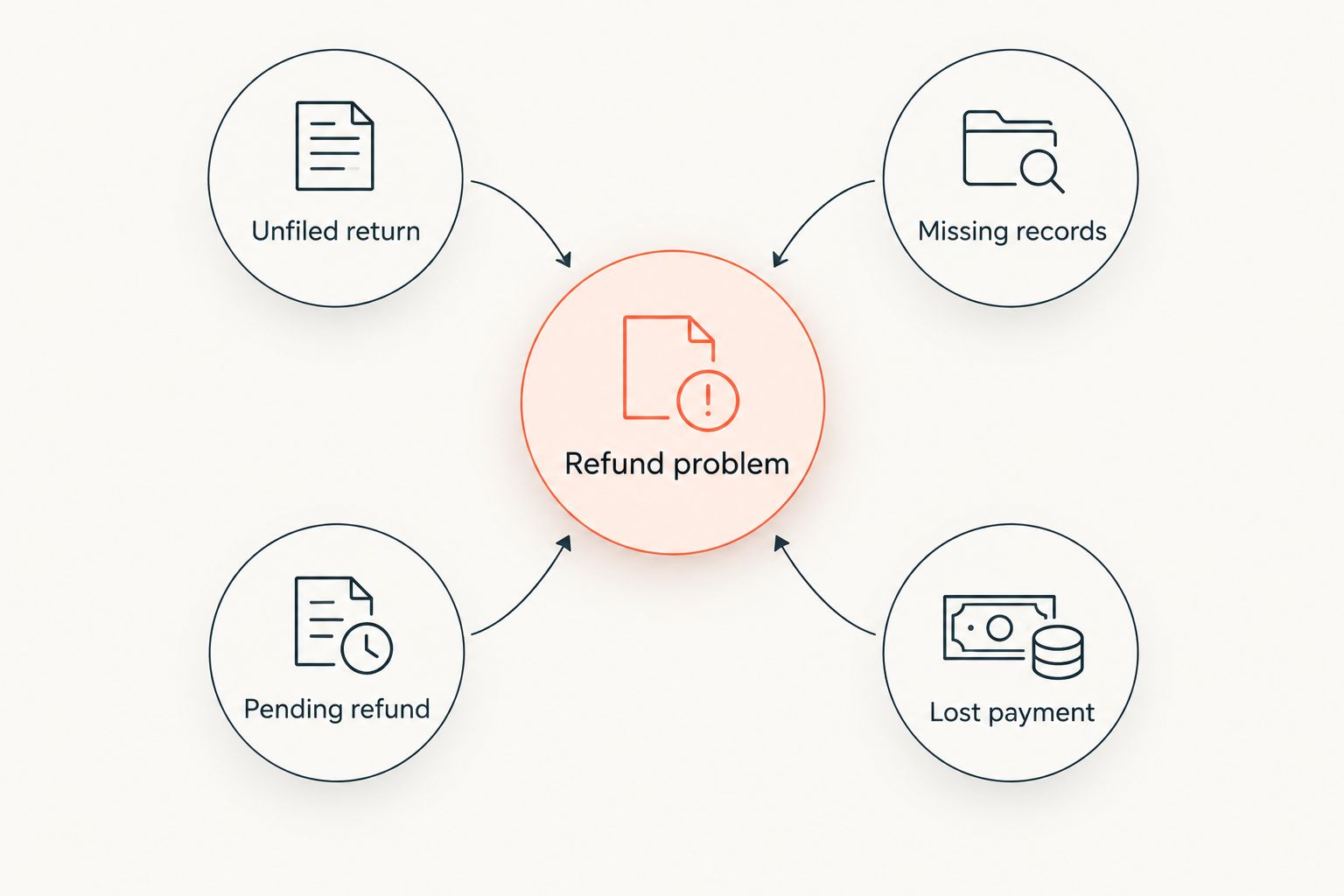
Before opening another search tool, describe the problem in one sentence. Use these four categories to separate a missing return from missing records, processing, or payment delivery.
- Unfiled return: You have not submitted the return for the tax year in question.
- Missing records: You need documents to prepare a return or understand account activity.
- Pending refund: You filed, but the IRS has not issued the refund.
- Lost payment: The IRS issued the refund, but you did not receive it.
Unfiled return
Prepare the relevant return to establish whether you are owed a refund. A name search cannot calculate withholding, credits, deductions, and tax liability for you.
Refund claims generally have a 3-year filing limit or a 2-year payment limit, whichever ends later, with additional rules limiting the amount recoverable and exceptions for some situations. For an older unfiled return, check the IRS instructions for that tax year promptly. Do not assume every deadline falls on the same calendar date.
Missing records
Identify the document you need before requesting transcripts. Income information, a copy of previously filed return information, and account activity answer different questions.
Compare available records with documents you already have. If something is missing or inconsistent, resolve that gap before treating an estimated refund as money you can claim.
Pending refund
Use the filed return’s exact details in Where’s My Refund? Read any message about further action, and check relevant IRS correspondence.
Do not file another original return simply because the refund is taking longer than expected. A processing delay is not proof that the return was never received.
Lost payment
Confirm the payment method and review the IRS instructions for a missing check or direct deposit. Keep the return details and any relevant correspondence together.
A refund trace addresses the issued payment. It does not replace an amended return when the underlying tax calculation needs correcting.
How we ranked these options
The 2026 ranking follows the criteria above: relevance, official authority, clear requirements, next steps, and limits. It is a task-based comparison, not a speed test or a claim that every option searches the same database.
Where’s My Refund? ranks first because it directly answers the most immediate filed-return question. Transcripts and account access support investigation. Refund Inquiries addresses payment delivery, while a private organizer serves the separate job of managing a broader search.
Which refund search tool should you choose?
Start with IRS Where’s My Refund? if you already filed. Choose Get Transcript when missing records block preparation, Individual Online Account when account activity needs explanation, and Refund Inquiries when an issued payment never arrived.
If you have not filed, the next move is return preparation—not another refund-status search. If you are checking other kinds of money that’s already yours, keep those searches separate from your IRS work. The right 2026 workflow is the one that identifies the responsible source and gives you a concrete next action.
FAQ
What’s the best tool to search for an unclaimed IRS tax refund?
IRS Where’s My Refund? is the best starting point for a refund from a filed return. For an unfiled return, gather the records and prepare the return to determine whether a refund is due.
Can I search for an IRS refund using only my name?
IRS Where’s My Refund? requires more than your name. You need your Social Security number or individual taxpayer identification number, filing status, and exact refund amount from the filed return.
Does an IRS transcript tell me exactly how much refund I can claim?
An IRS transcript does not by itself establish the refund you can claim on an unfiled return. It provides records that help with preparation or account review, depending on the transcript type.
Is Owedtoday a government refund website?
Owedtoday is not a government agency. It is a self-service tool for personalized unclaimed-money search lists and claim tracking; official claiming is always free.
What should I do if the IRS says my refund was sent but I never received it?
Follow the IRS Refund Inquiries instructions for the payment method involved. A refund trace addresses an issued payment that has not arrived, subject to the IRS timing and submission instructions.
Can I still claim a refund from an older unfiled return?
Eligibility depends on the applicable refund-claim deadline and your circumstances. Check the IRS instructions for the specific tax year rather than assuming that discovering the money starts a new deadline.
Are state unclaimed-property searches the same as an IRS refund search?
State unclaimed-property searches and IRS refund inquiries are different processes. Use the IRS for federal tax-return questions and the relevant state authority for property held by a state.
One last thing
No match is not the same as no refund. If you never filed the relevant return, a refund-status lookup is not a calculation of what you are owed. The missing step is establishing the claim through the correct tax process.
Before ending your 2026 search, write down the tax year, whether the return was filed, and whether the refund was issued. Those details tell you whether to prepare, investigate, track, or trace—and prevent repeated searches in a tool that cannot answer your question.